
Utilizing a commercial kitchen provides a wealth of opportunities and possibilities.
One of those options is to start a Home Meal Delivery business. There are two immediate options: 1) you can run this business – cooking, advertising, packaging, selling, etc. or 2) you can be the meal producer for a third party who does all the selling, provides you with the packaging, and you have no end-user communication. Both of these options are viable. For our explanations, we will assume you will be doing it all and shipping meals to a variety of locations in and out of state. Having a meal service that allows local walk-ins is a totally different situation, and is addressed within the Commercial Kitchens program.
If you elect option #2, you only need to sell yourself and services to one third party. Ideally that third party is a whiz at marketing and can do all the client interaction, selling and so forth. They will simply provide you with an order on a set day, and you will have X days (2 days is common) to produce, package the meals, and package for a UPS or Federal Express pick-up. The menus should be a collaboration between you and the third party, at least a week ahead of the order they will submit. This allows you enough time to ensure your food deliveries will cover the anticipated following weeks’ orders. Sometimes a company actually selling the product will maintain a constant menu to select from, and add weekly “specials”. If this is the case, you’ll want to know what the “specials” are, as they may be out of the ordinary for your food purchases. (More Salmon for example).
Option #1 means you are doing ALL of the above. Marketing, advertising, collecting payments and orders besides the cooking and packaging and shipping. Once you are established and getting orders, anticipate a minimum of 1 full time staff member to start, and 2 staff members once you really get up and going. These staff are dedicated to your Home Meal Delivery business. Option #1 is the most expensive for you, by far. Deep pockets will be required to successfully get into the game. Option #2 only increases your expenses by potentially adding full or part time staff for both the cooking and the packaging/shipping preparation.
In 2010, your competition was fairly minimal, as others were trying to enter this somewhat new option to address the “What’s For Dinner?” question. Some business owners tried to prep and portion size meals, and allow the customer to come in, order menu X, receive an instruction sheet for both the ingredients and the meal assembly/cooking. While there may be a few of these still in operation, most have faded away. Why? The customers needed to be local. And in reality, all you were proving were small packages of meats, veggies, etc. that had been put into baggies. A family of 4 needed to collect 4 baggies of each ingredient. Customers soon learned that there was almost zero savings. They still had to cook, and they were just buying precut items instead of visiting the grocery store.
Again, we’re going to assume that you are doing it all, and shipping meals. You will absolutely be dusting off all of your marketing and selling lessons. Without an order, you have nothing except some start-up expenses.
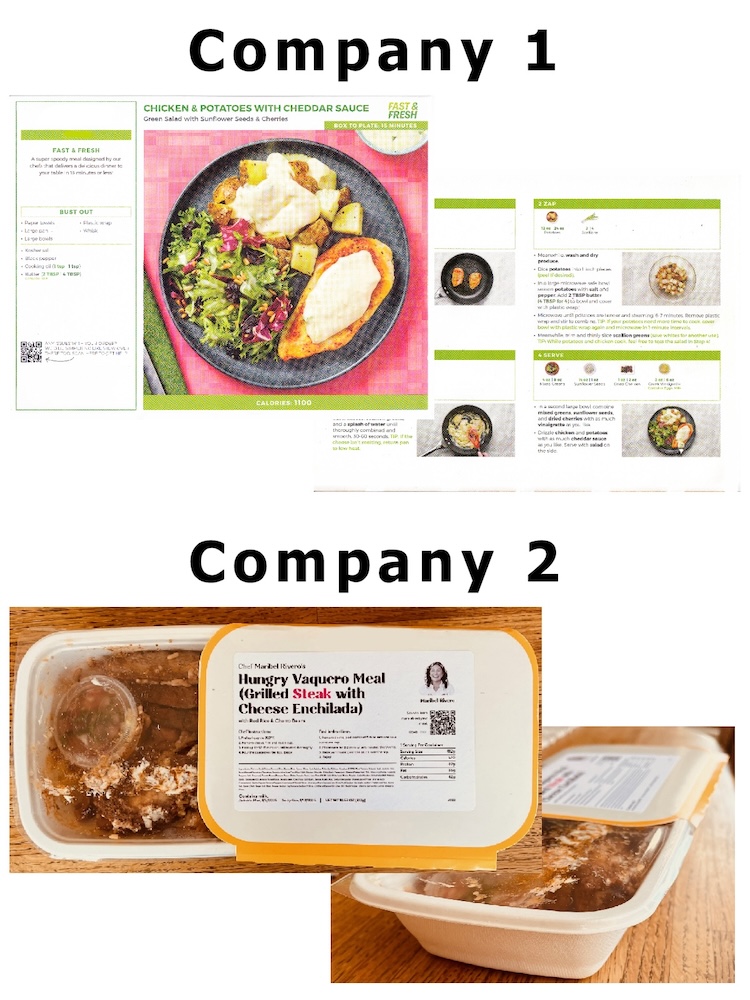
Let us discuss two of the major/national market companies and how they operate.
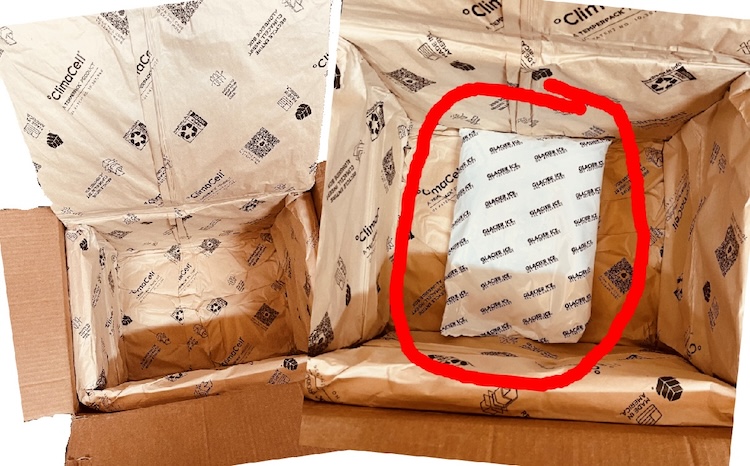
There are at least two major players in the supply of both insulated packaging and the ice gel packets. Climacell (temperpac.com) and Glacial Ice (glacialice.com). These will be ongoing expenses. Each order will require the proper packaging. You may be able to mass produce a meal at X per meal, but then there is another hard cost involved (plus shipping charges). About the only way to minimize these additional hard costs is through volume buying. This becomes another upfront expense every so often. Another consideration is that you’ll require a large freezing area to freeze the packaging ice gel to minus 10 degrees – and depending on your volume of sales, this issue can take up a lot of freezer space. Dry Ice is not recommended to keep meals cold. Dry Ice requires special handling, can get too cold, and only UPS will ship Dry Ice. Plus, Dry Ice is expensive.
The Pros:
1) Ingredients are separated and portioned. If you don’t want the onions, then don’t include them as you prepare the meal.
2) Each meal has a sturdy, detailed description of what amounts of what are needed, how to combine, and how to cook.
3) The recipe/instruction cards have a nice full color photo of the finished meals.
The Cons:
1) The customer has added time involved in meal assembly. And their accidental misreading or interpretation of a step may/can alter the finished meal – leaving them a bit unsatisfied with the entire process.
2) The consumer is providing the vessel used for actual cooking.
3) The customer is totally dependent on all the required ingredients to be in each bag. (The company used for our evaluation did have prompt customer service, and the solution to the missing ingredient(s) was a credit to your account. That is fair enough, but tonight you may not have a meal! In our 3 month evaluation, we did have the meat omitted from two different meals, which put the brakes on dinner tonight.)
Now on to Company #2, The customer will receive meals fully prepared in an oven ready container (one meal per container). Each meal packet is sealed with a clear film, but freezing this meal for later consumption comes with a cost. The “sealed” meal is not air-tight as a Personal Chef would prep for the freezer. Flavor/taste may be compromised to a point if this meal is frozen for later. The consumer would have the option of moving the meal to a different container and vacuum sealing – but now this involves added efforts (this could potentially be an approach for Company #1 as well). These premade meals come in an 8.5” x 6” x 2” oven ready container. The packaged meal is enveloped with a thin cardboard instruction sheet. Simply remove the film (and potentially a small plastic container of sauce to be applied at the time of consumption), heat as instructed, and serve. A transfer of this meal to a plate is certainly possible, but the containers themselves are not unsightly and will maintain the heat better.
The Pros:
1) No muss, no fuss. Straight from refrigerator to oven. All packaging may be recycled.
2) Packaging of each meal is professional and clearly describes what this meal includes, as well as nutritional data.
3) No missing ingredients.
The Cons:
1) The instructions on how to prep and heat the meal are in very small font, which could easily present a challenge for seniors or those visually affected.
2) The meal is the meal – if you don’t like onions, it’s up to you to pull these from the meal prior to or after after cooking.
3) The consumer has zero guidance on how to duplicate this meal, should they desire.
Both Company 1 & 2 offer special ordering instructions for those with dietary restrictions, which we applaud, however we did not place any such orders. And “special restrictions” generally come with an elevated meal cost. Imagine your kitchen producing 300+ of recipe A, but wait, 10 of these cannot have X ingredient. As the cooking facility, this puts additional stress/efforts for that particular meal. And if you are providing 4-6 unique meals for the week, your possibility of having serval meals being prepared differently, while still maintaining the flavor. But that’s why you, the chef, have those bits and pieces of how-to substitute information tucked away.
So, if you decide to venture down this potentially lucrative path – we highly recommend you first become involved with all the competitors. Order meals, and reorder. This is absolutely a business deduction (within reason). But then you must closely evaluate the pros and cons of each company, then ideally, arrive at a better mouse-trap by including this or that, and eliminating this or that. Remember that your paying customer expects minimal effort mouth-watering meals. Your expectation should be that these customers are looking to fill a void – the easiest, and cheapest way possible – with consistency of meal quality delivery.
For our comparisons, we believe that both Company 1 & 2 paid the same cost associated with the meal, be it the production of recipe cards, or the ready-to-go containers. Absolute and serious considerations to be involved in any decision making.
Regardless of if you do it all, or are simply providing the cooking and packaging part, you will first experiment with what these menus are (think 8 or more unique meals as a starter). Then, what packaging is best for your meals (size, material, etc.) If you can find one container that will work for all offerings, then you can buy in bulk and save a few dollars. Plus, you will be able to select your shipping box which holds X amount of meals (because the containers are all the same size). Shipping boxes will also be purchased in quantity, however you will need a few different sizes. And be sure to size your boxes with the insulation and ice gel packs included.
And as a final note – you really have no idea about the customer. If they are energetic and semi-skilled in the kitchen – well that’s one – but if zero kitchen skills or no desire to do anything more than pop in the oven, then eat – that is the million-dollar question you potentially face. Those factors are important to know when you begin, because as in Option 1 & 2 above, both offer pros and cons requiring serious consideration.
